VEGANS WANTED INTERNATIONALLY
We are recruiting only committed vegans who want to turn their values into measurable impact and income.
You will represent a revolutionary multi-function wrench at Agriculture and other trade shows, performing live demonstrations and direct sales in your country (USA, EU, AU, NZ, etc.).
Why this tool matters
- Vegan is embedded on both sides of the handle, planting a subtle yet powerful seed in the minds of carnivores.
- Proven in real-world tests — like Bangkok street demonstrations — this first design multi function tool sells itself, one set of four sized multi function wrenches every 2 minutes. The design and function are now far superior, making it irresistible.
- The patent pending wrench is the best multi-tool of its type in the world, giving every user a reason to buy. No debate required.
Your role
- Demonstrate. Engage. Sell.
- Do not argue. Do not debate. The Vegan message works on its own.
- Travel nationally or internationally and perform in high-pressure, public environments.
Pay: AUD $60/hour plus travel and accommodation.
This is NOT for you if:
- You are a snowflake vegan.
- You are motivated primarily by materialism or greed.
- You feel the need to debate or argue with carnivores.
- You cannot perform under high-pressure, public conditions.
Apply Only If:
- You are a strict vegan committed to your principles.
- You are ready to let the tool do the talking and plant the Vegan seed effectively.
- You are comfortable demonstrating, selling, and performing consistently under scrutiny.
This is a mission. Not a hobby. Not a discussion. Not a compromise.
Only apply if you are relentless, principled, and action-oriented.
A tool designed to speak for the animals
The patent pending Myark Multi-Function Tool is engineered for performance — but created with a purpose. The word VEGAN is permanently cast deeply on both sides of the handle, delivering a clear message every time the tool is picked up. No noise. No confrontation. Just a powerful reminder that compassion matters — seen by carnivores, tradespeople, farmers, and everyday users. This is activism embedded directly into a product.
Silent Advocacy
Our demonstrations are held at locations where non-vegans gather, such as agricultural shows and hardware expos.
Reaching the unreachable
Events meat eaters attend — not vegan events. When they approach the stand to admire the engineering, they see a tool they want… with VEGAN staring back at them.
Spreading the message
They watch demonstrations. They test it. They buy it. And from that moment on, they carry the vegan message everywhere the tool goes.
Stop killing animals
We’re Inviting VEGANS to Join Our Team. We are looking for committed vegan advocates to become: Demonstrators, Expo & market representatives and Promotional ambassadors. You will earn $60 each hour plus travel and accommodation expenses from demonstrations and product sales — while spreading a message that supports animal rights every single day.
What’s in it for you
Share a product that sends a message without conflict. Be part of the first tool brand built around vegan ethics. Help reach meat eaters and farmers — the hardest group for vegan advocacy. Join a supportive community of mission-driven partners. Represent a product with proven market appeal.
Who we want
Vegans who are passionate about helping animals, confident engaging with the public, excited to demonstrate a clever, practical invention, interested in earning income through ethical business and motivated to spread the VEGAN message in a new, intelligent way.
Past example of our animal rights activism
Three of the Myark amphibious folding trailer barges donated to SAFE "Save Animals From Exploitation" on opening day duck shooting with a band playing loud music to scare the ducks away.
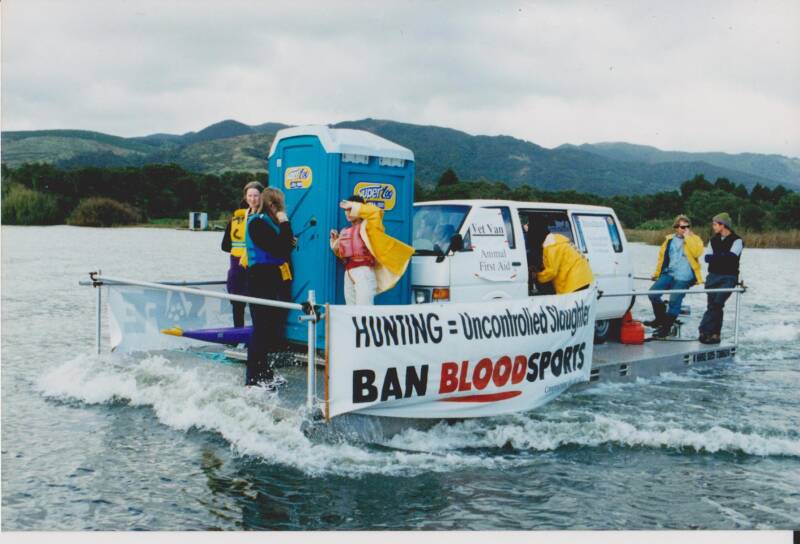
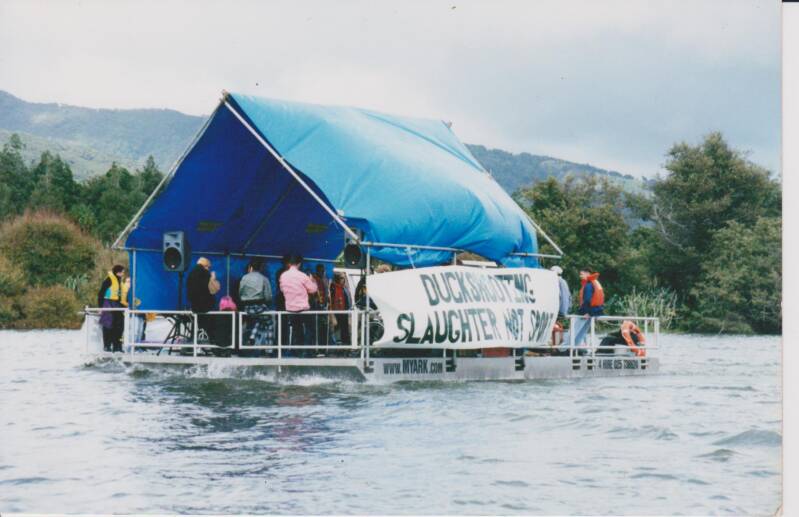
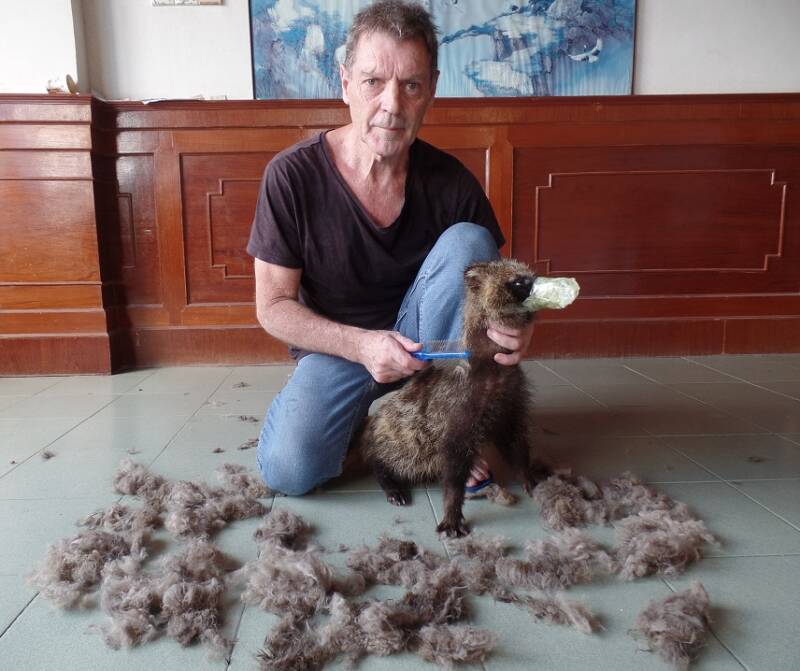
From back alleys to foreign streets, where no cameras roll and no heroes stand, Denis walks alone. The rescue of a tortured Raccoon Dog was only one chapter in the epic tale of a man who chose to fight when no one else would.


The image below shows Irada and Denis during a joint venture with the King of Tonga to manufacture Myark folding trailer barges, while attempting to save a dog that had been spear-gunned through the head and had wiggled free and escaped weeks earlier.
Denis later found the dog outside its owner’s business and, without hesitation, took it into his care. He paid for a close friend—a veterinary surgeon—to fly to Tonga with full surgical equipment to operate, at a cost of several thousand dollars.
A few days after the surgery, the dog stood, walked to Denis, curled into his arms, and died.


Pictured below are Denis and members of the King of Tonga’s team and bodyguards gathered by the limousine during the first stage of negotiations to build Myark watercraft in Tonga, while the King remains seated in the back of his bullet‑proof limousine.
The newspaper photograph below left marks a pivotal turning point in the Myark story.
At that moment, plans were abandoned to establish manufacturing operations in Tonga. What had begun as an ambitious international venture ended abruptly after a serious security incident, when Denis and his partner Irada were confronted by a large group of intoxicated locals. The situation rapidly became dangerous, and the decision was made that remaining in Tonga—particularly for Irada’s safety—was no longer possible.
Shortly after their departure, events in Tonga took a far darker turn. Following the death of the King, widespread unrest erupted in the capital. Nukuʻalofa was engulfed in rebellion, and much of the town was destroyed by fire. What had once seemed like an unfortunate setback was revealed, in hindsight, as a narrow escape.
The newspaper image stands as a silent witness to that decision—a moment when instinct, caution, and responsibility outweighed ambition. It marked the end of one chapter and the beginning of another, reinforcing a lesson that would shape every step forward: innovation can only survive where safety, stability, and human life come first.


Pictured: Denis rescuing a herd of cattle stranded on a river island during a major flood.
The animals had been trapped for several days and were severely weakened. The flooded treeline prevented them from swimming safely to the riverbank, as they risked becoming entangled and drowning.
In this image, Denis calmly persuades the exhausted cattle to board the Myark folding trailer barge. Despite their fear and fatigue, and after many hours of effort stretching into the early morning, Denis succeeded through patience, determination, and sheer ingenuity. Temporary modifications were made to the barge ramps, enabling the cattle to finally board safely and be rescued.
No one else knew how to save the cattle. The Myark folding trailer barge—named after Noah’s Ark—was instrumental in this rescue. Future sales of the barge are intended to support animal rights initiatives, including funding campaigns such as protests outside slaughterhouses.


While in China developing the start of the Myark multi-function wrench, Denis encountered a scene that would remain with him for life.
In the middle of a busy roadway stood a young boy, barefoot, unwashed, and severely malnourished. A large crowd had gathered—not to help, but to watch. The boy was behaving erratically, moving and gesturing like a wild monkey, while traffic carefully curved around him as if he were an obstacle rather than a human being.
One of Denis’s associates quietly asked, “Why doesn’t somebody help him?”
Denis replied instantly: “I am somebody.”
Without hesitation, Denis walked into the road, lifted the boy into his arms, and flagged down a taxi. The driver refused to take the child, saying he would dirty the vehicle, and demanded the boy be placed in the boot. Denis refused. He paid the driver extra and insisted the boy would sit on his knee so as not to soil the taxi. Eventually, the driver agreed.
The boy was gravely ill. He could not speak, showed severe developmental impairment, and had lived so long without care that his behaviour had become feral. Medical treatment revealed a shocking level of parasitic infection. After being given worm medication, the parasites expelled from his body filled the equivalent of a large can of spaghetti—a stark measure of the neglect he had endured.
Denis and Irada took the boy into their care and looked after him for nine months, nursing him back toward health and humanity. They fed him, cleaned him, protected him, and treated him with dignity and patience. But eventually, they were required to return to New Zealand.
With great difficulty and heartbreak, they found a brand-new orphanage willing to take the child into permanent care. Leaving him there was deeply distressing and emotional—an experience that neither Denis nor Irada ever forgot.
This moment reinforced a belief Denis has carried ever since:
How a society treats its animals is how it ultimately treats its people.


Denis was walking back to his apartment from a lost-wax investment casting factory on a bitter winter afternoon. The wind was cutting, the rain relentless, and the cold severe. As he walked, he noticed a man sitting nearby—wearing only torn pants, with no shirt, no shoes, and shaking violently from the cold.
Without hesitation, Denis took off his own jacket and offered it to the man, along with some money. The man reacted aggressively, telling Denis to leave him alone and insisting he wanted nothing. Denis refused to walk away. Over the following days, he returned again and again, bringing warm clothing and hot food. Each morning and afternoon, he tended to the man’s badly infected foot, cleaning and caring for the wound as best he could.
One day, the man disappeared.
Worried, Denis asked the factory workers to help search for him. They eventually found the man nearby, almost dead and unconscious. Denis immediately poured water into his mouth to attempt revive him, then had the factory workers load him into a van. Denis took him back to his apartment and cared for him until he regained consciousness and his life was saved.
Local people claimed the man was mentally ill—“crazy,” they said. But over time it became clear that this was not true. The man had simply given up on life.
Denis managed to convince the factory to offer him a job, hoping it would give him purpose and stability. But the man refused all help beyond the clothing and shoes Denis had given him. Eventually, he left again, choosing to disappear.
Denis was deeply saddened. He felt he had failed to help the man more—but he himself was struggling to survive, with very little to give beyond compassion, persistence, and what small resources he had.


While working on his inventions with a trusted Chinese friend and business partner—preparing to manufacture the latest Myark multi-function wrench—Denis suddenly heard screaming in the street.
He looked up to see a school student who had been struck by a car and thrown violently to the ground. The young man’s body convulsed uncontrollably, his head slamming repeatedly against the road in violent spasms. The gathered crowd stood frozen, many believing the student had been killed instantly.
Without hesitation, Denis sprinted forward.
He knelt beside the injured student, cradling and stabilizing his head to stop the impact against the asphalt. Speaking calmly and firmly, Denis continued to talk to him, urging him to fight and remain conscious. For nearly fifteen minutes he stayed there, shielding the student’s head and trying to bring him back from the edge of death.
Slowly, the student opened his eyes and regained consciousness—but he could not move.
Denis remained with him in the middle of the road, directing traffic to pass around them while continuing to comfort and reassure the injured young man. He did not leave his side until police arrived, followed shortly by an ambulance.
Over the years, Denis has lost count of the number of people he has helped—particularly the poor and vulnerable across China. A local newspaper once described him as a reminder of a soldier of the revolutionary era: who travelled throughout the country helping the misfortunate, earning trust, respect, and becoming household name through quiet acts of courage and humanity.

These photographs below were taken 28 years ago. In the first image, Irada is lining up Cambodian children so that, in the next photograph, Denis can hand out money to them—an act carried out with the permission of the border security guards.
What remains deeply disturbing is not only the level of extreme poverty, but the indifference surrounding it. Western backpackers routinely walked past these children, deliberately averting their eyes, refusing even to acknowledge their presence. Even more confronting was the contrast just a few hundred meters away: a large casino filled with wealthy foreign patrons, throwing money away as if it were water, while not a single cent was offered to the desperate children suffering in full view outside its doors.
Each time Denis went to Cambodia for renewal of his Thailand visa—something he had to do every three months—he departed Cambodia in uncontrollable tears, overwhelmed by the knowledge that he could not stay, and could not do more to help.

